
In 2005, the non-profit climate advocacy organization Architecture 2030 issued a challenge to the building industry to design carbon neutral buildings by 2030. Known as the 2030 Challenge, the initial target was for buildings to use 50% less fossil fuel energy, with incremental increases over a 25-year period. In 2009, the AIA launched the 2030 Commitment, an initiative asking signatory firms to track and report their progress toward the 2030 Challenge goals on an annual basis.
PAYETTE first signed the Commitment and reported our progress toward the 2030 Challenge goals in 2011 with an average reduction of 51% (the target that year was 60%). At that time, 170 firms had signed the commitment, but only about half reported projects that year. Over the years the community of reporting firms has grown significantly, and reporting now is more robust. According to the 2024 AIA report 2030 By the Numbers, 460 firms reported the performance of roughly 4 billion gross square feet of whole buildings and interior fit-outs. This represents 41,639 projects across 113 countries.
On March 31, signatory firms reported their progress toward the 2030 goals for the 2025 calendar year. This year, PAYETTE reported 10 whole buildings and 9 interior projects representing a total gross floor area of 3.5 million square feet. Of the project data reported, three key metrics are especially important as we close in on carbon neutrality in 2030; Energy Use Intensity (EUI), electrification, and embodied carbon.
Energy Use Intensity
The goal for reducing fossil-fuel based energy use in buildings from 2020 through 2024 was 80%. In 2025, this goal jumped up to 90%. The AIA 2030 Commitment uses the metric EUI as a proxy for evaluating performance of new and renovated buildings relative to this goal. According to 2030 By the Numbers, the industry wide average EUI reduction in 2024 was 56%. PAYETTE’s 2025 projects by comparison achieved an overall 61% reduction in EUI.
Historically, PAYETTE has outperformed the industry overall, even though our portfolio includes primarily labs and healthcare, some of the most energy intensive and complex building typologies. Our practice has been routinely pushing the boundaries of efficiency and performance for well over a decade. With robust envelopes, efficient space layout, and high-performance mechanical systems – we’ve been squeezing every Btu out of the proverbial orange.
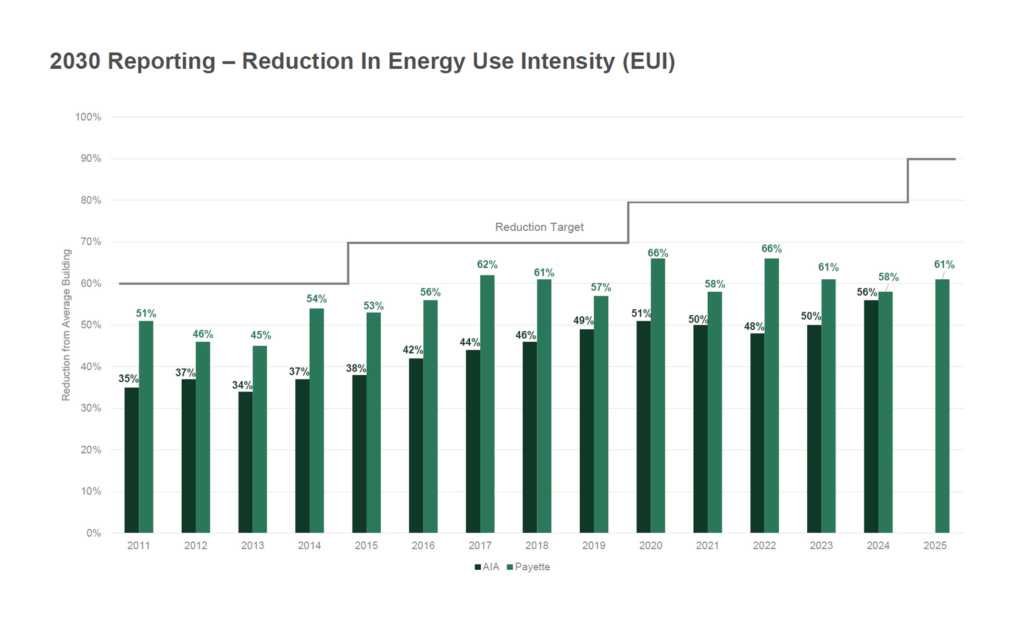
So, are we failing by not hitting the 90% target? Let’s remember that the goal is 90% reduction in fossil-fuel based energy consumption: EUI is just a proxy for measuring this. Strategies that drive down EUI were absolutely the place to start. First with high performance envelopes, then energy recovery, and finally meeting reduced energy demands with efficient systems. But efficiency can only get us so far toward our carbon neutral goal. The reality is that even efficient, high performing buildings use energy and always will, and cutting energy use at the building by 90% is not always feasible. Many projects are approaching the limits of what can be achieved through efficiency. What comes next is a shift to where we are getting that energy from, which is often beyond the bounds of architecture.
Electrification
Shifting from fossil fuels to renewable energy systems at the building scale almost always means moving toward all-electric systems. The AIA report 2030 By the Numbers highlighted significant progress in building electrification in 2024. A total of 1,558 all-electric buildings were reported, a 67% increase over 2023, and another 952 buildings were at least 75% electric. Most of these projects are likely to have stand-alone all electric systems. But there are different ways to go all electric; that is, it does not always have to be at the building scale.
Many of PAYETTE’s clients are institutions with large campuses and our projects often connect to central plants that generate steam or hot water for heat. Some institutions are taking a centralized approach to decarbonization, planning a transition to renewable energy replacements (e.g. ground source heat pumps) to existing fossil fuel-based central plants. These are significant investments in infrastructure that take both time and money to implement.
This approach to decarbonization includes shifting to low-temperature (130-140ºF) hot water systems, which are compatible with electrified sources of generating hot water. While the decarbonization of our client’s central plants is outside our scope of work, PAYETTE can enable future decarbonization by incorporating low-temperature hot water heating systems in our buildings (This strategy can also support decarbonization at a buildings scale).
Of the 10 whole building projects PAYETTE reported in 2025:
- 1 (very small) project is designed with ground source heat pumps and PV
- 9 buildings are designed with low temperature hot water heating systems
- 7 buildings are connecting to campus heating systems, 2 of which will connect to a geothermal based campus system
- 1 building is almost all-electric but includes fossil fuel-based systems for peak heating (~0.5% of total energy consumption)
- 1 project includes air-source heat pumps for 25% of the heating load and natural gas boilers for the remainder
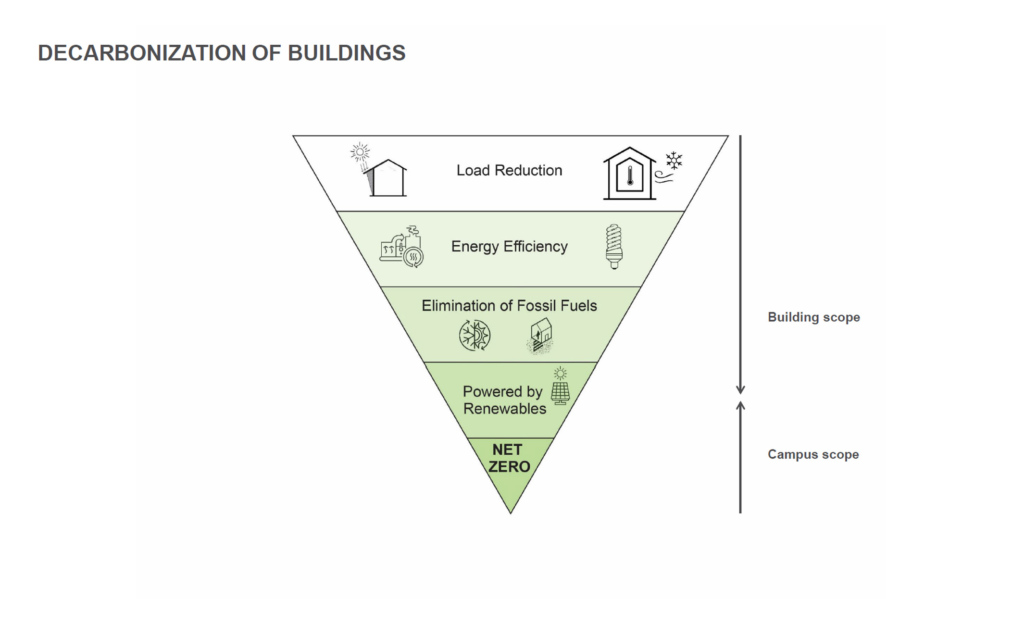
At PAYETTE, we explore the unique opportunities within each project to minimize energy use and climate impacts. We will continue to focus on designing low-load, efficient, and renewable-ready buildings as well as educating and advocating for renewable energy sources to power them. While we do this, we are expanding our focus on carbon from primarily operational to total carbon, which also accounts for embodied carbon impacts.
Embodied Carbon
In 2020, the AIA 2030 Commitment began tracking projects that reported embodied carbon. While the AIA 2030 Commitment does not have a specific reduction target for embodied carbon, the total number of projects and gross floor area evaluated for embodied carbon impacts has increased rapidly. PAYETTE began evaluating projects for embodied carbon in 2019 and in 2025 modeled 71% of our reported projects (by gross floor area).
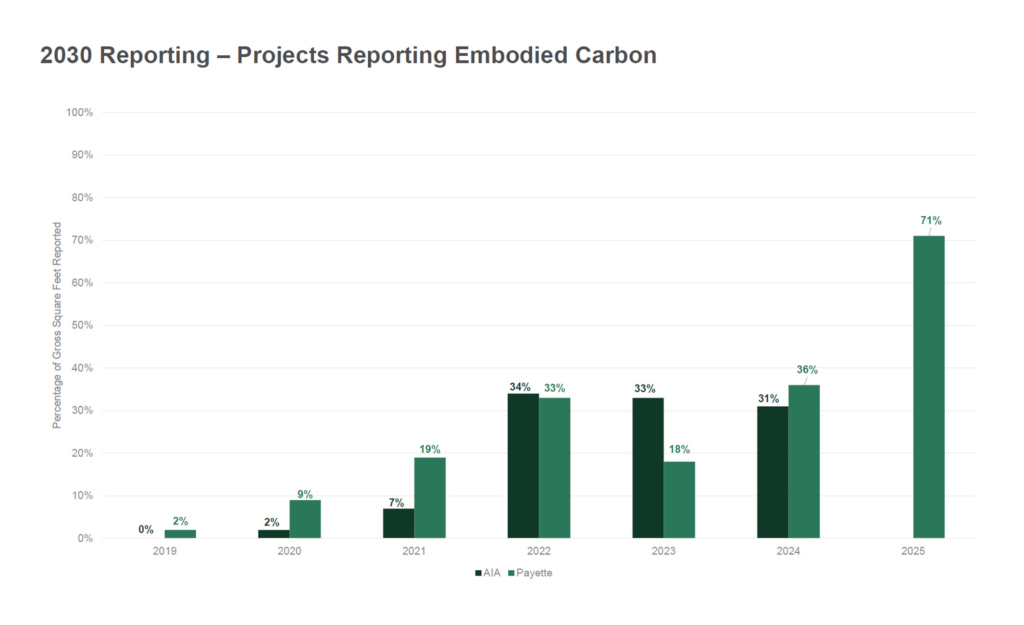
Of the projects PAYETTE reported in 2025, 5 included embodied carbon data with an average reduction of 18%. Achieving savings for each project involves keeping an eye out for any available opportunities, capturing “a little bit of everything,” and aggregating the reductions into something more significant. However, depending on the scope of the project, we frequently target:
- Lower embodied carbon concrete
- Replacing XPS roof insulation with poly iso
- Specifying lightweight gypsum wall board
- Using less material (e.g. embossed metal studs instead of standard)
- Eliminating materials and finishes we don’t need (e.g. open ceilings instead of acoustic ceiling tiles)
- Substituting lower embodied carbon materials or products
Closing in on 2030
Driving down EUI remains an essential component of meeting the climate challenge, but efficiency at the building scale alone will not ensure we meet our carbon neutral goal. The path forward includes pairing low-load, efficient building design with electrification, and providing renewable sources of energy, but the specific ways we do this can vary from project to project. At PAYETTE, we will continue to design buildings that are not only high-performing today, but adaptable to the energy systems of tomorrow. We will seek opportunities to engage and educate our clients in long-term decarbonization planning. And we will expand our lens to total carbon impacts, including embodied carbon alongside operational. We look forward to continuing the progress of our industry toward our collective goal of carbon neutral buildings.


OpenLAB Boston F26 has arrived!
Our OpenLAB studio provides a unique collaboration between practice and academia, offering a radical pedagogy for architectural education that embeds students and their studio courses within our office. This allows students to learn, experiment, absorb, and synthesize the multiple facets of architectural practice almost instantaneously, accelerating their education, deepening their understanding of architecture, and facilitating an effective entry into the profession.
We’re thrilled to welcome our 14 students from Virginia Tech, Hampton University, and Mississippi State University, who have hit the ground running, building their studio site model.
#architecturestudent #architecture #boston #architecturemodel #fabrication